

Security operations can easily distinguish alerts, and predict critical areas for response.
Predictive Security
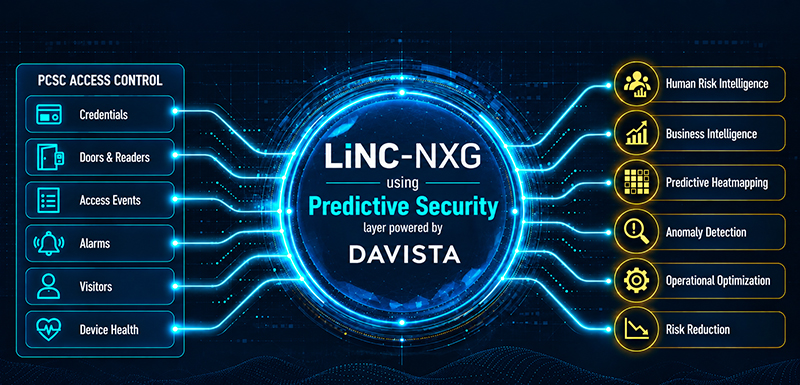
LiNC-NXG with Predictive Security, powered by Davista, adds an intelligent visual and analytical layer to PCSC’s LiNC-NXG management platform—helping security teams see, understand, and respond to what is happening across their physical environment.
Overview
By transforming the data already being generated by LiNC-NXG into actionable visual intelligence, Predictive Security powered by Davista helps move access control from simply recording events toward understanding activity and anticipating where attention may be needed.
LiNC-NXG continuously generates valuable information from the physical security system, including door entry events, alarms, access activity, camera triggers, and other system events. PCSC’s Predictive Security, powered by Davista analyzes this information to reveal patterns, activity levels, relationships, and changes that may be difficult to identify through conventional event monitoring alone.
The result is a more comprehensive view of the security environment. Activity can be presented through intuitive visualizations and dynamic heat maps that help identify areas of increased activity, recurring events, potential concerns, and changing conditions throughout a facility or campus.
Beyond analytics, the solution can help make security operations more proactive. Automated and Suggestive Guard Tours can use current system activity to help direct personnel toward areas that may warrant additional attention, creating a more dynamic approach to physical security. Predictive Security requires LiNC-NXG, and is an add-on layer.
 Download Datasheet | Download Press Release

AI Predictive Device Maintenance, identify problems before they become operational failures.
Feature Sets
-
AI-Powered Security Intelligence — Applies advanced analytics to data generated by PCSC’s LiNC-NXG physical security management platform.
-
Visual Security Analytics — Transforms complex system activity into intuitive visual information.
-
Dynamic Activity Heat Maps — Visually identify areas experiencing increased alarms, access activity, or other security events.
-
Alarm Event Analysis — Analyze alarm frequency, location, patterns, and changes overtime.
-
Door Entry Analytics — Identify unusual, elevated, or recurring access activity.
-
Camera Event Integration — Incorporate camera triggers and related events into the broader security picture.
-
Automated Guard Tours — Support automated security patrol workflows based on defined conditions and system activity.
-
Guard Tours Module — Help direct guards toward areas where current activity may warrant additional attention. Refer to optional Guard Intelligence Module.
-
Pattern Recognition — Identify relationships and recurring patterns across multiple types of security events.
-
Activity Trending — Monitor changes in employee movement from the “norm” to help identify emerging conditions.
-
Facility-Wide Visibility — Provide a consolidated visual perspective across buildings, floors, zones, doors, and other monitored areas.
-
Actionable Intelligence — Help security personnel move beyond individual alerts toward a broader understanding of what is happening.
-
Leverages Existing LiNC-NXG Data — Adds intelligence without requiring the underlying access control system to be replaced.
-
Scalable Predictive Security — Establishes a foundation for expanding AI-driven analytics as organizational security requirements evolve.
See what’s happening. Understand the patterns. Know where to focus.
Schedule a Demonstrative Consultation
See what your security system can tell you—before you have to ask.
Contact PCSC Today
Ideal Applications
AI Predictive Security Layer for LiNC-NXG is for: Campuses, Schools and Universities, Data Centers, Utility and Industrial Facilities, Hospitals and Healthcare Infrastructure, Financial, Commerical and Corporate Buildings and much more.
- Guard Force Optimization – dynamically prioritize patrols, locations and activities based on changing risk rather than static schedules.
- 24/7 Control Centre Optimization – correlate alarms, video, access activity and historical patterns to prioritize events and focus operators on the highest-risk conditions.
- Video Monitoring & Virtual Patrols – use predictive intelligence to determine where and when virtual patrols should occur rather than relying solely on predefined tours.
- Alarm Intelligence / False Alarm Reduction – identify recurring nuisance patterns and contextualize alarms using multiple data sources before escalation.
- Access Management Intelligence – add behavioral baselining, anomaly detection, and insider-risk capabilities to traditional access management.
- Physical Response Optimization – use risk, location, incident history, and real-time conditions to improve dispatch and response decisions.
- Predictive Device Maintenance – identify degrading cameras, access devices, alarms, and other security infrastructure before they become operational failures.
- Enterprise Risk Intelligence – provide users with a unified view across traditionally siloed physical security systems and services.